The Willits v City of Los Angeles Settlement from 2014 set in motion a series of events including allocating $1.4 billion by the City of Los Angeles to repair urban sidewalks in the City over a 30 year period that began in 2017. To streamline the process, the City prepared a Draft Environmental Impact Report (EIR) that would establish the procedures, monitoring and responsibilities of various parties in the “sustainable” practice of street sidewalk repair minimizing environmental impact while providing a blanket approach to all projects. The EIR does not go nearly far enough to protect Los Angeles’ urban forest.
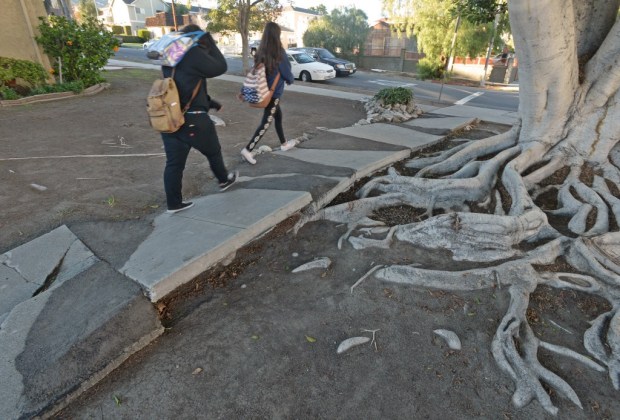
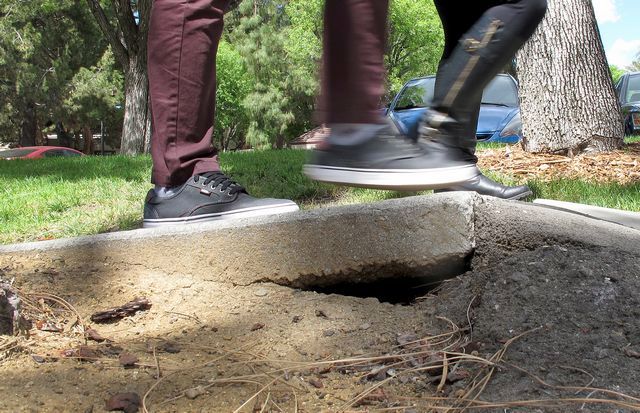
We must do everything we can to preserve the valuable trees we have today. According to recent studies, US Cities are losing 36 million trees per year1. Los Angeles needs to plant 90,000 trees in the next decade to reduce the temperature, reduce air and noise pollution and improve the aesthetics of the city. The City of Seattle has developed a comprehensive tree management plan that should serve as a model for Los Angeles. The two most important benefits of trees, cooling and cleaning the air, will be lost for a generation at the very time we are in dire need of improving both of these things. A recent study published just how much canopy cover is needed to cool the streets such as Sepulveda; we need much more than we have today.
One of the more contentious issues in repairing sidewalks is the removal of over 12,000 mature trees2 throughout the City’s 9,000 miles of sidewalks. The proposed project plan would see the replacement of these trees at a 2:1 and 3:1 ratio depending on the phase of the 30 year effort. While that seems impressive, in my mind, there are 3 key considerations in understanding the impact of this effort. I will illustrate these considerations with our own local situation: the proposed removal of 6 Indian Laurel Fig (aka, ficus) trees on the east side of Sepulveda Blvd in Westchester between 78th and 79th street.
A 2:1 ratio, covering 2/3 of the project period, seems like we would end up with more canopy cover than we have today; however, based on the species of the trees to be planted, the EIR finds that the replacement trees will only reach roughly 60%3 of the canopy of their replacements at full maturity. So, if all goes according to plan, at maturity we may have slightly more canopy than we do today. One concern is that these replacements may not be planted where the originals were removed; they may be a mile or more away in a location convenient to the contractor.
The second concern is that the trees are estimated to take from 20-30 years to reach maturity with an EIR-estimated 8% mortality rate (the City of Santa Monica’s arborist suggests their mortality rate is closer to 20%). So, for the next 20+ years, we will have considerably less canopy than we do today at a time when we face dire climate conditions with rising temperatures and ongoing air quality problems. Also, tree mortality is generally caused by vandalism, accidents and inadequate climate conditions such as watering; the EIR claims these will be disease free without any substantiating evidence to back that up.
Finally, while the EIR stipulates that trees will be replaced within 1 year of removal and that tree mortality will be monitored for 3 years and replaced if necessary4 (at which point they are considered to be established), there do not appear to be any means to ensure / enforce these standards. I am also skeptical that the urban Forestry Division (UFD) have the resources that some 1,000 tree saplings in various stages of maturity (years 0-3) can be monitored and at what frequency will they be monitored and do we use 311 if we see a tree dying or dead?
So, to understand what is at stake, I turn our focus locally to a very admirable and by all measures successful project managed by the Westchester Streetscape Improvement Association (WSIA) lead by John Ruhlen. Over the past 30 years they are raised an impressive amount of money from local business and other supporters to make improvements to sidewalks and other urban features within Westchester. Unfortunately, recently they have stalled but now seek to finish a section of their project which they claim requires the removal of numerous trees including 6 ficus trees on Sepulveda Blvd between 78th and 79th streets5.
First, a glimpse of what they are removing and what they replace them with. The replacement saplings appear to have a roughly 4 inch diameter with almost no canopy to speak of yet.
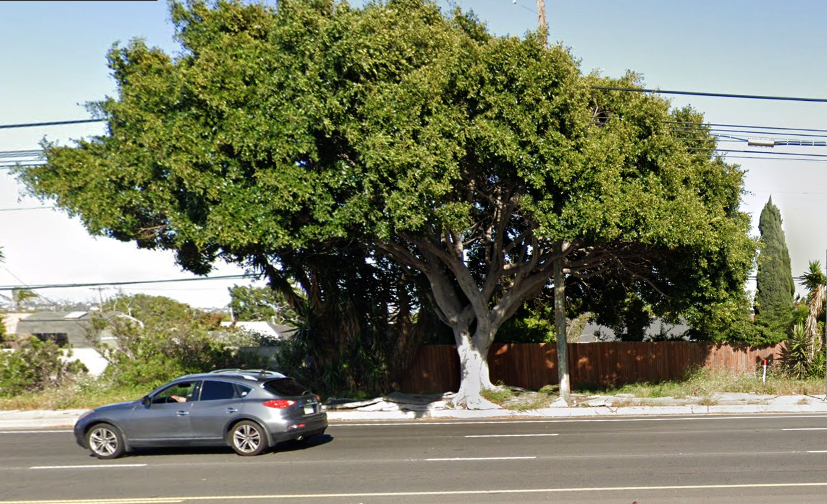
One can see that this tree has caused considerable damage to the sidewalk.
One can also see that this tree has a roughly 2,800 square foot canopy (30 ft radius estimated from car length), something that would be lost for over a generation of residents of Westchester and travelers through LAX.
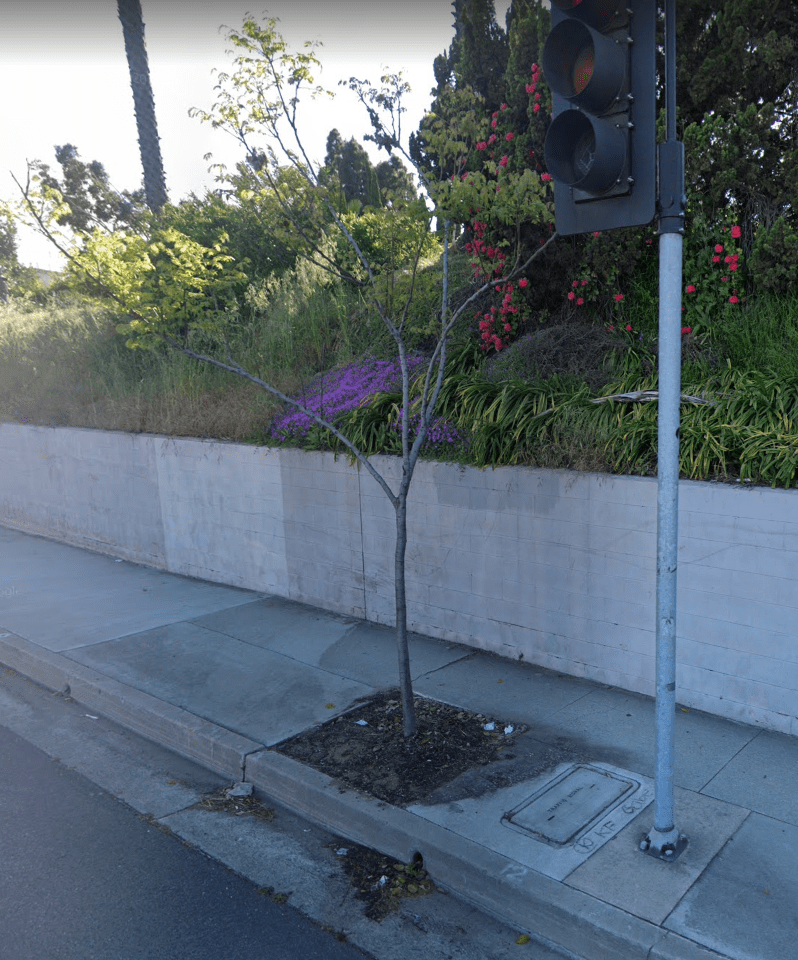
This tree has no canopy and will be a decade at least before it does.
As you can see from the images above, these tree removals represent a significant loss of canopy. The loss of canopy results in increased heat in the area, increased air pollution and a loss of nesting habitats for birds, bats and raptors among other things.
What should the City and organizations like WSIA do instead of removing these majestic trees? There are several measures that can be taken for trees that present current or imminent threat of damage to sidewalks. These include easements to route the sidewalk around the current and future root ball, reducing the sidewalk width to 4 feet as allowed by the ADA requirements, creating meandering sidewalks, building bulb-outs (where the sidewalk extends into the current road right of way to be combined with bicycle lanes and other uses) and pruning the tree roots in a manner that will not impair the tree’s health. In the case of the 6 ficus trees, there appears to be ample space to acquire the necessary easements to route the sidewalk around the existing tree growth.
A question remains, how long will these improvements last? If we route a sidewalk around a tree, won’t the roots eventually grow to damage the recently rebuilt sidewalk? Looking at the tree root growth along Sepulveda from 2009 to 2019, the root balls do not appear to have grown substantially if at all. I would need to verify this with an arborist, but my understanding is that they generally reach a maximum vertical growth. It might be that the ficuses on Sepulveda were not planted at the appropriate depth and thus their roots naturally grew up to meet their default size.
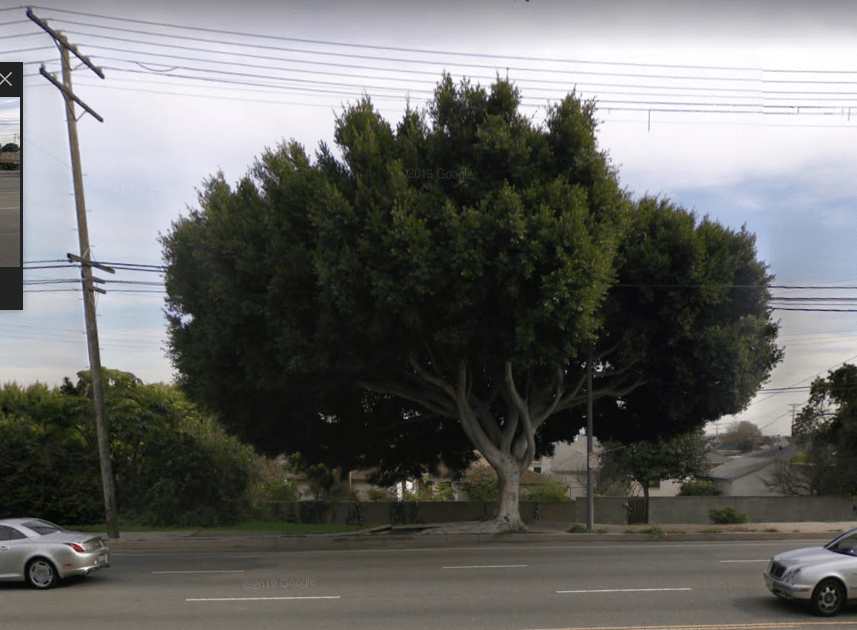
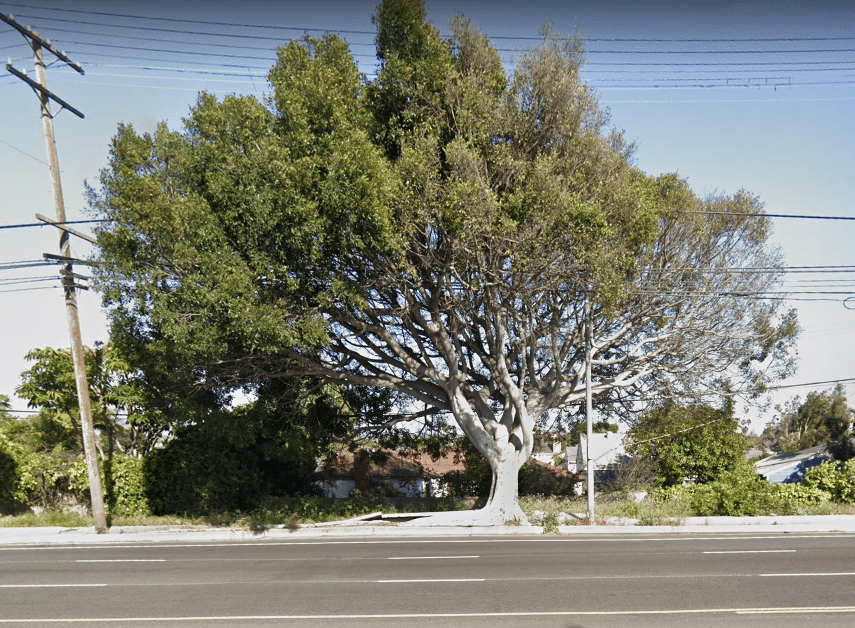
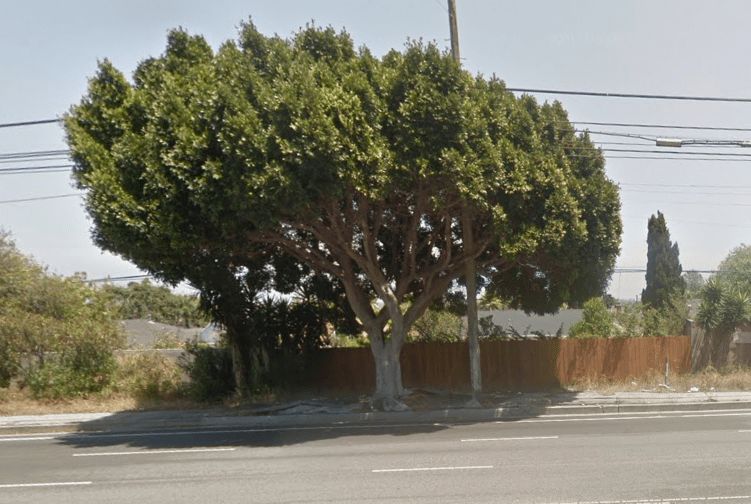
The two images above are of the same tree separated by roughly 10 years. One thing that is unfortunate is that it appears the tree in 2019 is not as healthy as the tree from 2009 with many empty branches on its right side. A little further up the street we see another tree with views from 2012 and 2019. This tree also appears to have stopped or at least slowed significantly its impact on the sidewalk.

1https://www.sciencedirect.com/science/article/pii/S1618866717307094?via%3Dihub
2https://sidewalks.lacity.org/sites/g/files/wph661/f/2.0%20Project%20Description.pdf pg 2-31
3https://sidewalks.lacity.org/sites/g/files/wph661/f/3.3_Biology.pdf pg 3.3-29
4https://sidewalks.lacity.org/sites/g/files/wph661/f/2.0%20Project%20Description.pdf pg 2-47
5http://boe.lacity.org/docs/dpw/agendas/2020/202001/20200131/bss/20200131_ag_br_bss_1.pdf
 Exploring Westchester / Playa Neighborhoods with Data